
My Story...
FixPickensAirport.com was created after I was denied access to my local public-use airport—an airport funded in part by taxpayer dollars and subject to federal obligations.
More than four years ago, I filed a complaint with the FAA. Federal records show that the airport engaged in discriminatory and unfair treatment. Despite this, the county has continued to spend public funds on legal efforts aimed at restricting my access. They even used my disability against me after they were told by the FAA not to. It's all in the documents.
Today, policies remain in place that are not applied equally to all users, raising serious concerns about compliance with federal grant assurances that require fair and non-discriminatory access to publicly funded airports.
This is not just a local issue.
Across the country, there are growing concerns that some publicly funded airports are using taxpayer resources to exclude certain types of aviators—particularly ultralight pilots—through selective enforcement, inconsistent rules, and legal barriers.
A special thanks to Kristin, Jon Stidham and Travis Burns at OneUp Adventures for all their support. I would've given up had it not been for them pushing me.
Advocacy for Equal Airport Access
The FAA investigation revealed Pickens County’s violation of nondiscrimination laws by imposing unjust and unsafe limits on ultralight flights. We work to educate the public, advocate for pilot rights, and promote safe, inclusive aviation environments.
FAA Findings of Non-Compliance
The FAA ruled that Pickens County violated Grant Assurance 22 (Economic Nondiscrimination) in several primary ways:
- Hazardous Operational Requirements: The County forced operations into a hazardous taxi lane near obstacles, rejecting two safe grass areas previously identified by FAA Flight Standards.
- Safety Overreach: The FAA emphasized that the County cannot substitute its own judgment for FAA safety determinations.
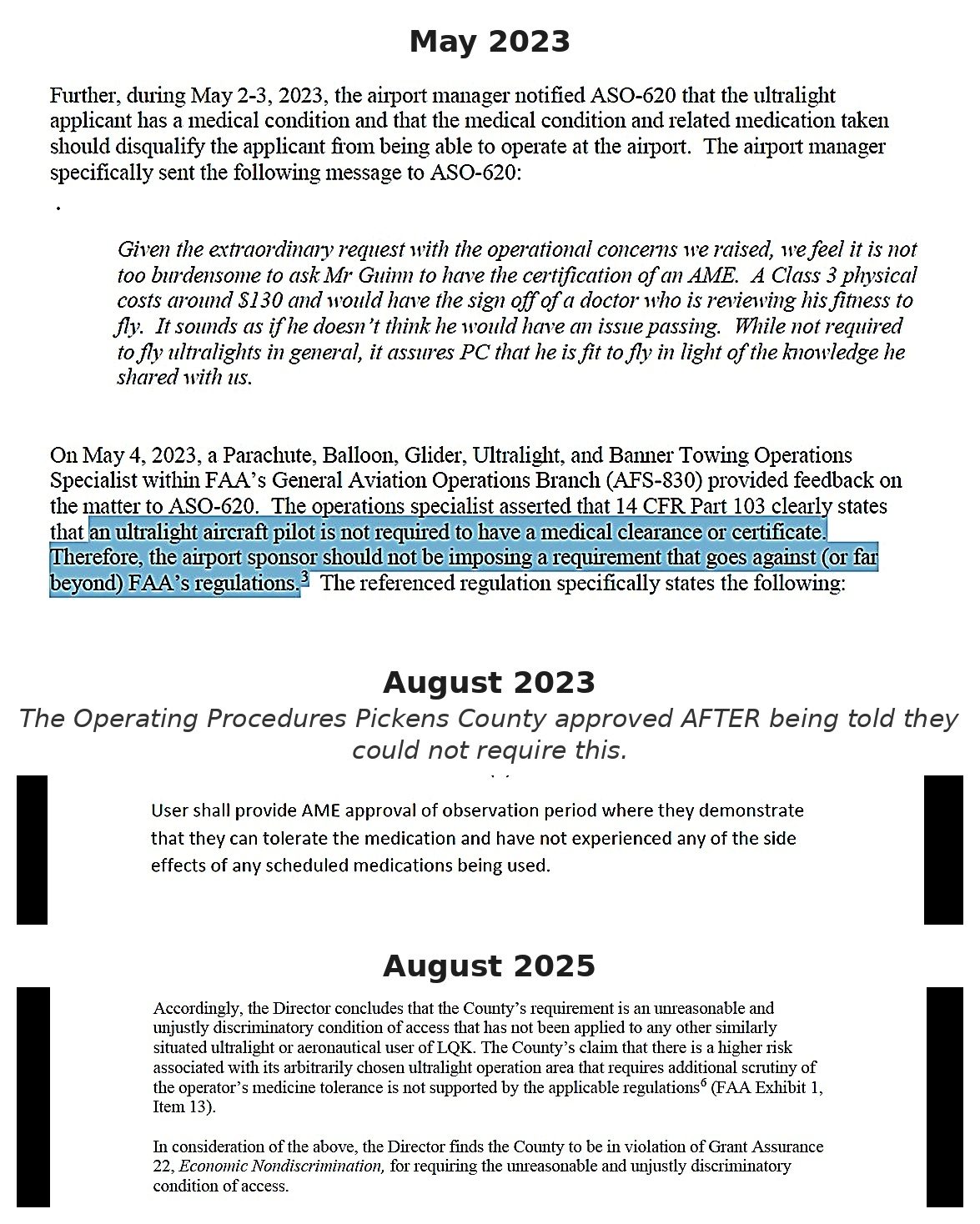
- Unlawful Medical Mandates: The County required an Aviation Medical Examiner letter due to the pilot’s diabetes medication. The FAA confirmed this was arbitrary and discriminatory, as Part 103 pilots are not required to hold medical certificates.
- Unreasonable SOP Restrictions:
- Scheduling: The County limited flights to specific weekday windows that were unsafe for ultralights and inconsistent with federal regulations.
- Financial & Equipment Barriers: The County imposed a $50 per-flight fee, a $250,000 liability insurance requirement, and mandatory two-way VHF radios—none of which were found to be reasonable, justified, or applied equally to other users.
Resolution and Impact
The FAA ordered Pickens County to provide immediate access to safe locations and threatened the withholding of federal airport improvement funds if a Corrective Action Plan (CAP) was not implemented. After hiring outside counsel and unsuccessfully attempting to appeal the ruling in late 2025, the County withdrew its appeal in February 2026 and accepted the corrective action conditions.
What happened next is in the FAA section below.

The FAA
The FAA’s first move is almost always to push the airport sponsor and the pilot to “work it out.” In reality, this process rarely leads to any meaningful resolution. Instead, it creates delays and gives the airport time to stall.
Throughout this process, the FAA repeatedly warns the airport about the risk of losing federal funding. However, those threats are rarely enforced. Airport sponsors know this, and take advantage of it.
In my case, the Director’s Determination should have been the turning point—and on paper, it was. The FAA found that the county had imposed discriminatory and unsafe restrictions and required them to submit a Corrective Action Plan (CAP). Instead of correcting the problem, the county spent over $30,000 so far in taxpayer money on an aviation attorney to fight it.
Even more concerning, key provisions—such as the insurance and access agreement—were pushed through during the CAP process. I was excluded from that process. When I asked the FAA Division Manager for transparency, I was dismissed and told those discussions were between the FAA and the county.
Let that sink in: the FAA identified discrimination, required corrective action, and then allowed the process to happen behind closed doors without the affected party.
This all came after an FAA specialist (AFS-830) acknowledged that while the airport claimed safety concerns, those concerns were largely self-created.
This isn’t just bureaucratic inefficiency. It’s a system that allows federally obligated airports to delay, deflect, and quietly preserve discriminatory practices—while appearing compliant on paper.
Tactics Airport Managers Use to Deny Access
Weaponized Bureaucracy
Ordinances are written to be difficult to change, requiring multiple readings and prolonged procedures—even when they conflict with FAA grant assurances.
Delay Through Endless Appeals
Every decision is appealed, not necessarily to win, but to stall. Time becomes a tool to exhaust and discourage individuals from continuing.
Inventing Fees to Restrict Access
Airports impose layers of fees—“through-the-fence,” “ramp,” “administrative,” and creating financial barriers where none should exist.
Spending Public Money to Fight the Public
Taxpayer dollars are used to hire aviation attorneys to defend questionable policies. Even partial victories are treated as justification for continued resistance.
Pushing Dubious Insurance Requirements
Liability insurance is sometimes required despite unclear FAA guidance, placing unnecessary burdens on individuals while the issue remains unresolved.
These tactics don’t promote safety—they discourage access. And in many cases, they raise serious questions about compliance with federal obligations and fair treatment.
WOW! What a coincidence. Yuba airport, 2000 miles away, did the exact same thing Pickens airport did within the same year. What are the odds?
Council Meetings showing how they will deny access
Here are prime examples of a county council bending over backwards to block something the FAA has already deemed SAFE. Listen closely—you can hear them scrambling for words because they don’t have a real argument.
Pay attention to the phrases they hide behind: “safety restrictions” and “heavy hand.” Those aren’t facts—they’re excuses.
And for the record, the last two members speaking, voted out last year. That didn’t happen by accident.
Here's the county ignoring the FAA and discriminating against my medical condition. How would that make you feel?
They were told in May 2023 they could not require medical certification.
In May 2025, they formalized those same requirements in an SOP anyway.
August 2025, the Federal Aviation Administration ruled those requirements unjust and discriminatory.
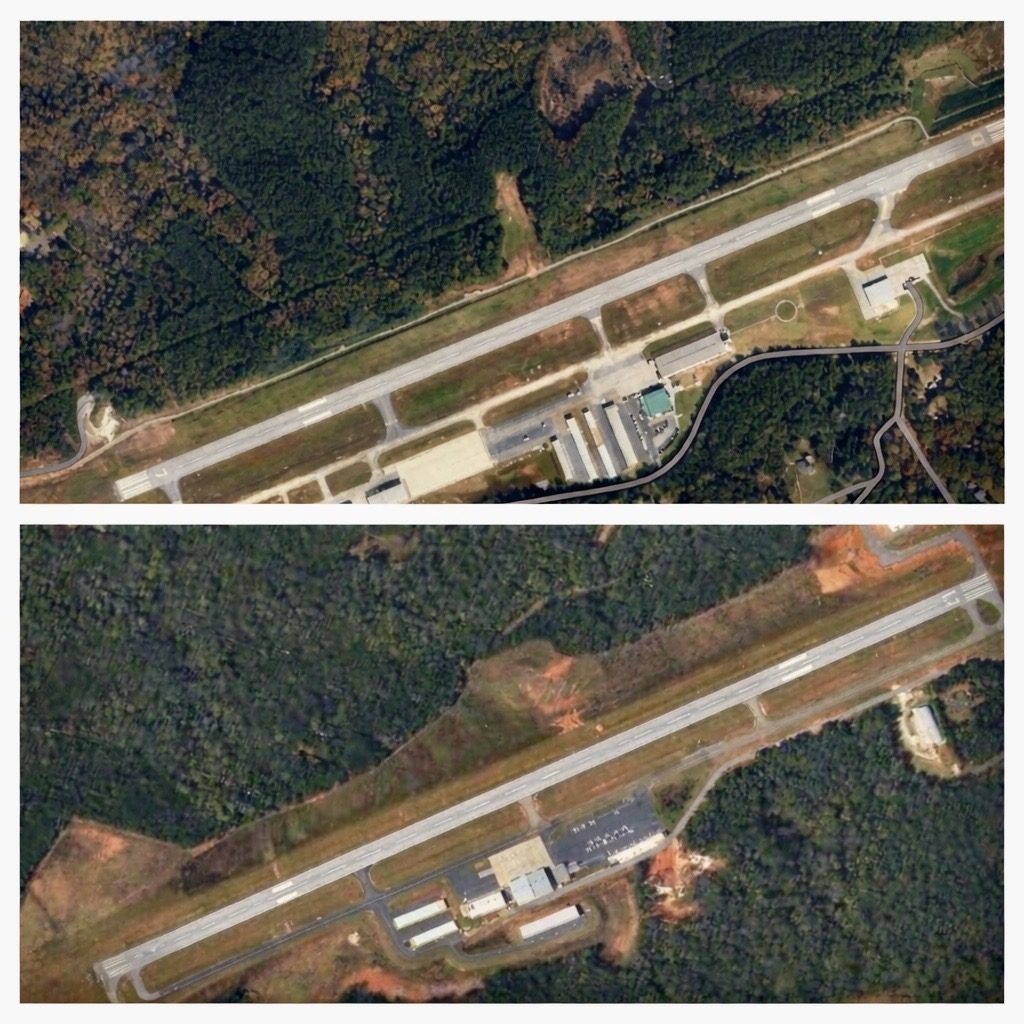
Pickens thinks it's unique!
These two airports sit just 13 miles apart, funded by the same federal dollars. They handle similar traffic. They’re built nearly the same.
Yet one chooses to harass ultralight pilots with unecessary rules and restrictions—while the other simply follows the FAA’s guidance under FAR Part 103 and welcomes us without issue.
Let’s be clear: this isn’t about safety. It’s about control. One airport respects federal law and pilot freedom—the other thinks it’s above both.
Pickens county resources so far;
- Greater than $30,000 tax dollars for attorneys (1 aviation, 1 county)
- 53 months of correspondance and counting
- 5x agendas on council meetings
- 2 ordinance changes
- 1 Corrective action requirement
Continuous Awareness
Providing updated information and resources regarding ongoing advocacy efforts.
The links below are the complete set of documents for downloading. I will update as more documents are provided.
If you need help with what to do about your airport, contact me.
Pickens, SC